


Managing business expenses sounds simple enough: set a policy, collect receipts, approve claims and keep records up to date.
In practice, finance teams know it is rarely that neat.
Receipts arrive late. Claims need checking. Approvals get stuck. Spend happens across different teams, locations and payment methods, often before finance has a complete view of what has been spent.
As a business grows, those small inefficiencies become much harder to ignore. A process that once worked with a spreadsheet, shared inbox or manual approval flow can quickly turn into a monthly scramble of chasing, correcting and reconciling.
That is where a more structured approach to expense management matters. With the right processes and software in place, businesses can reduce manual work, apply policies more consistently and give finance teams better visibility over company spend before month-end pressure sets in.
What is business expense management?
Business expense management is the process of tracking, approving, reimbursing, reporting and controlling company spending.
It covers the everyday costs employees incur while doing their jobs, as well as the systems and policies finance teams use to review, record and manage those expenses.
Common business expenses include:
- Travel expenses
- Mileage claims
- Meals and entertainment
- Office expenses
- Software subscriptions
- Vendor payments
- Employee reimbursements
A strong expense management process gives businesses a clearer view of where money is being spent, helps ensure spending follows company policy and keeps financial records accurate.
Why is managing business expenses important?
Expense management plays a direct role in budgeting, reporting, compliance and financial control.
Without a clear process, finance teams often only get a full picture of spending after the fact. By then, receipts may be missing, costs may be coded incorrectly and month-end reporting becomes more stressful than it needs to be.
Good expense management helps businesses:
- Improve visibility into spending
- Build more accurate budgets
- Maintain compliance and audit readiness
- Reduce unauthorised or unnecessary spending
- Speed up month-end and year-end reporting
It is not just an admin process. Done well, expense management helps finance teams protect cash flow, spot spending patterns earlier and support better business decisions.

How can businesses manage expenses in 7 steps?
No two organisations manage expenses in exactly the same way. Policies, approval flows and reporting requirements vary from business to business.
Still, the most effective expense processes tend to have a few things in common: clear rules, consistent data, timely reviews and automation where manual work creates unnecessary friction.
1. Separate personal and business expenses
Mixing personal and business expenses creates extra work for everyone.
When employees use personal cards for business purchases, finance teams need to validate claims, manage reimbursements and reconcile transactions manually. That can work at a small scale, but it becomes harder to control as spending increases.
Business accounts and company cards help create a cleaner separation. They also make reporting more reliable because spend is easier to track from the moment it happens.
Want to reduce out-of-pocket claims? Learn how company cards can give finance teams better control over employee spend. Learn More.
2. Create a clear expense policy
A good expense policy should make decisions easier, not create more questions.
Employees need to know what they can spend, what requires approval, which documents are needed and how reimbursement works. The clearer the rules, the less time finance teams spend dealing with exceptions or answering the same questions repeatedly.
Expense management software can help by applying rules automatically, flagging policy issues earlier and giving teams a consistent way to manage approvals across departments or locations.
3. Use consistent expense categories
Finance teams cannot analyse what they cannot compare.
If expenses are categorised inconsistently, reporting becomes messy. Trends are harder to spot, budgets are less reliable and forecasting becomes more guesswork than insight.
Most businesses use categories such as travel, accommodation, mileage, software, office supplies and marketing. The exact categories matter less than applying them consistently across the organisation.
4. Collect receipts and supporting documents early
Ask any finance team where time disappears in the expense process, and missing receipts will be near the top of the list.
Receipts provide proof of spend, support compliance requirements and help prepare for audits. They also reduce the need for finance teams to chase employees weeks after a purchase was made.
Digital receipt capture makes this easier. Instead of keeping paper receipts until month-end, employees can upload them as soon as the expense happens. That means fewer delays, better records and less follow-up.
5. Set up approval workflows
Expense reports often get delayed for simple reasons. The approver is unclear. The claim sits in someone’s inbox. A manager is travelling. Nobody knows what the next step is.
A structured approval workflow removes that ambiguity. Expenses can be routed automatically based on department, spend amount, expense type or cost centre.
When approvals are set up properly, they stop being a bottleneck. The right people still have oversight, but reports keep moving.
6. Review spending regularly
Expense reviews should not only happen at month-end.
Regular reviews help finance teams spot budget overruns, unusual spending patterns, policy exceptions and opportunities to reduce costs while there is still time to act.
For many organisations, a monthly review cycle is enough. Larger businesses, or those with higher spend volumes, may need more frequent monitoring to stay in control.
7. Automate expense management
Manual expense processes often hold up well until they suddenly do not.
A process built around receipts, spreadsheets and email approvals may be manageable for a small team. But as the business grows, every additional employee, location and payment method adds more admin for finance.
Automation helps reduce that burden. It can capture expense data earlier, route approvals automatically, apply policy checks and give finance teams a clearer view of spending in real time.
More importantly, it frees finance teams from low-value admin, giving them more time for analysis, forecasting and strategic work.
What is the best way to track business expenses?
The best way to track business expenses is to use a process that is accurate, scalable and easy for employees to follow.
Some businesses start with manual tracking or spreadsheets. These methods can work at first, but they become harder to manage as spending grows.
| Method | Advantages | Limitations |
|
Manual tracking |
Low cost, simple to start |
Time-consuming, error-prone, difficult to scale |
|
Spreadsheets |
Flexible and familiar |
Limited visibility, version control issues, manual reporting |
|
Expense management software |
Automated, scalable, real-time visibility, policy controls |
Requires implementation and user adoption |
For growing organisations, expense management software usually offers the strongest balance of efficiency, visibility and control.
What are the most common business expense management challenges?
Expense management rarely becomes difficult because of one single issue. It usually breaks down through a combination of small problems that build over time.
More employees start spending. More locations need oversight. More payment methods are introduced. Receipts arrive in different formats, approvals happen in different places and finance is left piecing everything together after the money has already been spent.
The most common challenges include: lost receipts, late submissions, policy violations, limited spend visibility and manual data entry.
How do businesses deal with lost receipts?
Lost receipts create more than an inconvenience. They can delay reimbursements, weaken audit trails and make it harder to prove whether spending was valid.
Digital receipt capture helps prevent this by allowing employees to scan and submit receipts as soon as an expense occurs. That reduces the risk of paper receipts being lost and gives finance teams the supporting documents they need earlier in the process.
How can businesses reduce late expense submissions?
Late submissions often happen because employees leave expense reports until the end of the month, or because the process feels too time-consuming.
Mobile reporting, automated reminders and simpler submission flows can make a significant difference. The easier it is to submit expenses on time, the less finance has to chase later.
How can businesses prevent policy violations?
Policy violations happen when employees submit expenses that fall outside company guidelines, either by mistake or because the rules are unclear.
Automated policy controls help by flagging exceptions before approval. This allows finance teams to manage issues earlier and apply policies more consistently across the business.
How can businesses improve spend visibility?
Many finance teams only get a clear view of spending once reports are submitted or reconciled. By then, it may be too late to prevent overspending or correct behaviour in the moment.
Real-time visibility gives finance teams a more current view of company spend. That makes it easier to track budgets, spot unusual patterns and act before small issues become bigger ones.
How can businesses eliminate manual data entry?
Manual data entry slows finance teams down and increases the risk of errors.
Receipt scanning, automated expense capture and accounting integrations reduce repetitive work by moving data between systems more accurately. That means fewer clerical errors, less duplicate entry and cleaner reporting.
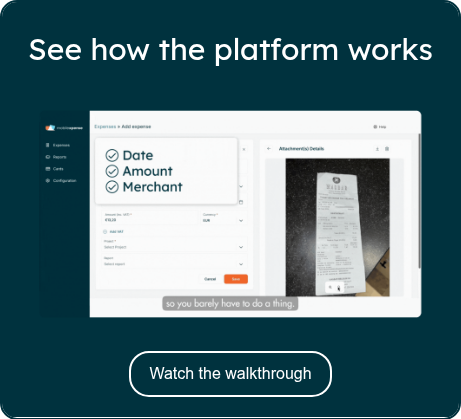
See how Mobilexpense can help solve your expense challenges
When receipts go missing, approvals stall and spend data only becomes clear after a claim is submitted, expense management quickly turns into extra work for finance.
Mobilexpense helps bring more structure to the process. Expenses are captured earlier, approvals keep moving and finance teams get better visibility before month-end becomes a scramble.
What features should businesses look for in expense management software?
The right expense management software should make life easier for employees while giving finance teams stronger oversight.
Key features to look for include:
- Receipt capture
- Mobile expense reporting
- Automated approvals
- Policy controls
- Mileage tracking
- Corporate card integrations
- Accounting integrations
- Multi-currency support
- Reporting and analytics
- Real-time spend visibility
A good solution should reduce manual work, support compliance and help finance teams manage spending with more confidence.
How does Mobilexpense help businesses manage expenses?
Spreadsheets, email approvals and scattered receipts might work for a while. Then the business grows, spend spreads across more people and locations, and finance is left piecing everything together after the fact.
Mobilexpense gives finance teams a cleaner way to manage expenses. It helps capture spend earlier, automate approvals, apply policy checks and show what is happening before month-end becomes a scramble.
With Mobilexpense, businesses can:
- Automate expense capture and receipt collection
- Create approval workflows that match company policies
- Manage mileage claims efficiently
- Gain real-time visibility into company spending
- Integrate expenses with accounting systems
- Connect existing corporate cards
- Support multi-country operations
- Improve compliance and policy enforcement
- Reduce reimbursement delays
- Strengthen reporting and forecasting
The outcome is simple: less time spent chasing expenses, and more time for the finance work that actually moves the business forward.
Ready to simplify business expense management?
Managing company expenses should not depend on endless spreadsheets, email chains and manual follow-ups.
Mobilexpense helps finance teams build a more structured expense process, reduce admin and gain better control over company spending.
See how Mobilexpense can help your organisation streamline expense management and make month-end easier to manage.
Share this

Mobilexpense vs Rydoo: A 2026 Spend Management Tool Comparison
/Listing%20Images/Achieve%20VAT%20Compliance%20With%20The%20Right%20Expense%20Solution.png)
Mobilexpense vs Circula: Which 2026 Spend Management Platform Is Right for You?