



Understanding Expense Management in 2026
If you're a finance manager in 2026, you already know this: expense management can’t stay manual. The role has shifted. It’s become about having full visibility, in real time, across every transaction.
That means one thing. Your systems need to do more of the work.
You might be thinking about an expense solution. Or you might not have the budget or bandwidth right now. Either way, standing still isn’t an option. Something has to change.
This blog aims to provide seasoned insights, blending foundational concepts with practical strategies, to enhance your financial leadership in managing and optimising expenses.
What is expense management?
Expense management refers to the process of tracking, analysing, and ultimately controlling business spending.
It could include a variety of tasks like recording receipts to preparing expense reports. For small and mid-market companies and new finance managers, mastering this discipline can be the key to keeping your company's finances in check.
The benefits of expense management
- Employees have better cost control by gaining clear visibility into spending, helping them manage budgets, reduce unnecessary costs, and protect operating margins.
- Teams work faster with smarter technology by automating manual tasks, reducing errors, and simplifying processes so more time can be spent on strategic work.
- Finance ensures stronger compliance by keeping every expense tracked, documented, and aligned with company policies and regulations, reducing risk and avoiding penalties.
- Employees experience faster reimbursements through streamlined processes that remove delays, reduce frustration, and minimise administrative stress.
- Leaders make more informed decisions with access to accurate, real-time data that supports better budgeting, forecasting, and financial planning.
- Businesses adapt easily to modern work by managing remote and hybrid expenses more efficiently, with better tracking and reimbursement processes.
Benefits for CFOs and finance teams
Finance teams:- Reduce manual effort and errors by replacing time-consuming processes with automation.
- Gain stronger cost control by tracking every expense, preventing hidden costs.
- Ensures stronger compliance by enforcing policies consistently, reducing the risk of penalties.
- Unlock reliable, integrated data by connecting expense systems with financial tools.
- Improve cash flow visibility by tracking expenses in real time, avoiding unpredictable cash flow and enabling better financial planning.
Benefits for employees
Employees:
- Experience faster reimbursements through streamlined processes, reducing delays that negatively impact morale and day-to-day finances.
- Experience less confusion with clearer policies with structured systems in place.
- Spend less time on admin thanks to simplified expense submission and tracking, reducing frustration and administrative burden.
- Are better supported in remote and hybrid work environments, with processes that handle different expense types consistently and fairly.
Benefits for corporate leaders
Leaders:- Make more informed decisions with access to accurate, real-time spending data
- Protect the business from financial instability by avoiding overspending.
- Improve overall cost control by ensuring all spending is visible, monitored, and aligned with business goals.
- Adapt to modern work with systems that handle complex, distributed expense needs while maintaining consistency and control.
- Reduce organisational risk by ensuring compliance with tax laws and internal policies, protecting both reputation and financial health.
Why is expense management important?
If you think expense management is only about tracking where every cent goes, you might learn a thing or two about how it can be done better.
Expense management should primarily focus on capturing and analysing employee expenses in a smart way.
It should also match the company’s financial goals and objectives.
Effective expense management helps in:
- Identifying cost-saving opportunities
- Ensures regulatory compliance
- And plays a vital role in risk management
By maintaining a clear view of the organisation's expenses, finance leaders can make informed decisions that drive long-term sustainability and growth.
Common expense management challenges
Despite its importance, expense management presents several challenges:
-
Manual efforts and inefficiencies: Time-consuming manual processes can lead to errors. Inefficiencies arise from a lack of automation, leading to higher costs.
-
Hidden costs: Small, unauthorised expenses can add up, creating hidden costs. Lack of robust monitoring can lead to fraudulent expense claims going undetected.
-
Integration issues: Integrating expense systems with financial software is often complex, leading to fragmented data. Without integration, reporting and analytics become challenging, limiting insights into spending trends.
-
Remote work complications: Tracking expenses across different locations and work setups can complicate compliance. The variety of expense needs for remote employees can lead to inconsistent policies.
- Policy compliance issues: Policies are everywhere, from internal rules like restricting alcohol purchases to external regulations that require employees to receive specific meal allowances while travelling. Managing these policies can quickly become complex, especially when cross-border travel, hybrid work, and local compliance requirements are involved.
Types of expense management solutions explained
You might be joining the club of the majority of finance managers who find their current expense process to be slow and costly.
Yes, costing time can add up to be expensive too. Arguably, the most expensive resource a company has is its people.
Organisations use various expense management software solutions to streamline expense reimbursement and reconciliation.
This section explains six different types of expense management solutions, their key features, limitations and best use cases.

1. Spreadsheets and manual tracking
Some smaller or medium-sized businesses still use spreadsheets and manual tracking to manage expenses. Employees enter expenses manually with Excel, attach receipts and submit reports via email. This method is low-cost and easy to set up, but comes with major drawbacks and frustrations.
Spreadsheets and manual tracking techniques are best for micro-businesses with low transaction volumes and no budget.
2. Basic expense reporting tools
These tools already offer an upgrade from spreadsheets, allowing employees to submit expenses digitally. They usually include mobile receipt scanning, basic policy enforcement and approval workflows.
Basic expense reporting tools are best for small teams that need simple, affordable automation but won't get full visibility over policy alignment or enforcement.
3. Corporate card-based expense management
Some solutions focus on automating corporate card transactions. These tools sync transactions in real time, allowing finance teams to track card spending and enforce card-based policies.
Corporate card-based expense management options are best for businesses with high corporate card usage. (These can be virtual or physical cards)
4. AI-powered and automated expense management
These solutions use artificial intelligence (AI) to process expenses automatically, detect fraud and enforce compliance.
According to Gartner, artificial intelligence can assist in automating routine tasks, enhancing data analysis and improving decision-making processes in expense management.
Using AI has increased efficiency and limited manual errors. But it's not without AI-hallucinations. Outputs should always be cross-checked and never left to fully replace a human being.
AI-powered and automated expense management options are best for growing businesses needing policy automation and compliance controls.
-1.png?width=1200&height=713&name=Product%20Mobile%20mockup%20(No%20background)-1.png)
5. ERP-integrated expense solutions
Large enterprises with complex financial structures often require ERP-integrated expense solutions. These systems connect directly to ERP platforms (SAP, Oracle, Microsoft Dynamics) for seamless expense tracking, tax reporting and compliance management.
ERP-integrated expense solutions are best for enterprises needing full financial system integration.
6. End-to-end travel and expense (T&E) platforms
Travel and expense (T&E) platforms like Perk combine travel booking and expense management in one system. Employees book flights, hotels and transport directly through the platform, while expenses are automatically recorded and categorised.
Best for businesses with frequent employee travel.
The expense management process
Expense management isn’t a one-off task. It’s a cycle. One that keeps spending visible, controlled, and consistent across the business.
From the moment an expense is created to the point it’s analysed, every step plays a role in keeping your finances accurate and your processes efficient.
The process below outlines the expense process if you were to use an automated expense software tool like Mobilexpense:
Step 1: Expense creation and capture
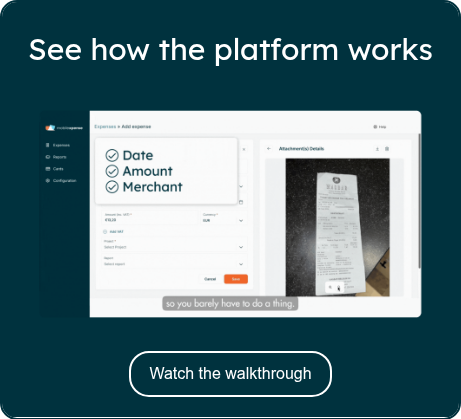
John needs to submit an expense claim because he paid for a train ticket during a business trip. He uploads the receipt straight away using the expense tool. The tool captures the amount, date, currency, and supplier automatically, so he does not need to enter everything manually.
Step 2: Expense submission
John reviews his expenses and submits them in one report. The tool keeps everything organised and checks that the required proof of purchase is included before submission.
Step 3: Review and approval
John’s manager receives the expense report for approval. The tool checks the expenses against company expense policies and routes them to the right approver, helping finance stay compliant.
Step 4: Reimbursement and reconciliation
Once approved, John is reimbursed. The tool helps finance reconcile the expenses correctly in the accounting system and keeps records accurate in the background.
Step 5: Reporting and analysis
Finance uses the expense data to review spending patterns. The tool provides reports that show where money is being spent, where costs are increasing, and where spending may need more control.
This is a typical expense flow that John follows, but in reality, there can be variations depending on the type of expense.
For example, if John pays with a company card, adds mileage, or logs a car-related expense, some parts of the process may change. Certain steps can become more automated, require different approvals, or follow separate reimbursement and reconciliation workflows.
Key features to look for in expense management software
-
Automated receipt capture and OCR: Receipts shouldn’t be entered manually. They should be scanned, extracted, and processed instantly. Less effort. Fewer mistakes.
-
Policy enforcement and controls: Policies shouldn’t live in a PDF. They should be built into the system, flagging or blocking non-compliant expenses in real time.
-
Approval workflows: Approvals need structure. The right people review the right expenses, at the right time. No confusion. No delays.
-
Accounting and ERP integrations: Your systems need to talk to each other. No duplicate work. No data silos. Just one source of truth across finance.
-
Real-time reporting and analytics: You shouldn’t have to wait for insights. Real-time data gives you immediate visibility into spending, so you can act faster and plan better.
Expense management vs. spend management
Expense management focuses on what happens after money is spent: tracking, submitting, approving, and reimbursing employee expenses.
Spend management goes further. It covers the entire lifecycle of spending, from procurement to payment, giving you control before, during, and after the money leaves your business.
That’s the difference between reacting to spend and actually controlling it.
First steps to implementing an expense management system
Embarking on the journey of implementing an expense management system can seem daunting at first, but by breaking it down into manageable steps, the path becomes clear. Reflecting on the essence of expense management, it's about more than just keeping tabs on costs; it's a strategic approach to ensuring every cent contributes to your business' success.
- Start with the fundamental step of establishing a clear expense policy that sets boundaries and expectations, providing a blueprint for financial decision-making.
- Next, define a clear approval process, ensuring a balance between flexibility for employees and control for the business.
- Then, set up a fair and efficient reimbursement system, because timely compensation is key to maintaining trust and morale.
- And finally, start recording expenses. By capturing every transaction with accuracy, you're laying the groundwork for robust financial health.
There are a variety of tools available to support you with these processes, from receipt tracking apps to multi-faceted solutions that offer automation and detailed reporting. Integrating these tools can significantly reduce the administrative burden and potential for error, allowing you to focus on strategic business initiatives.
Closing thoughts
By understanding why expense management is vital (preventing unnecessary losses, maximising resource allocation, and providing valuable financial insights), you can appreciate its role in the broader financial narrative of your company.
Mobilexpense supports customers across Europe and beyond (from Kaaiman Reizen, Hunter Douglas to SpendLab), each with their own workflows, integrations, and compliance needs.
Whether that means connecting with systems like ADP or supporting bring-your-own-card (BYOC) programmes. While your expense challenges may feel unique and complex, our solution is built with flexible workflows and European business realities in mind.
Share this

How to Manage Business Expenses Effectively in 2026
Mobilexpense vs Rydoo: A 2026 Spend Management Tool Comparison
/Listing%20Images/Achieve%20VAT%20Compliance%20With%20The%20Right%20Expense%20Solution.png)